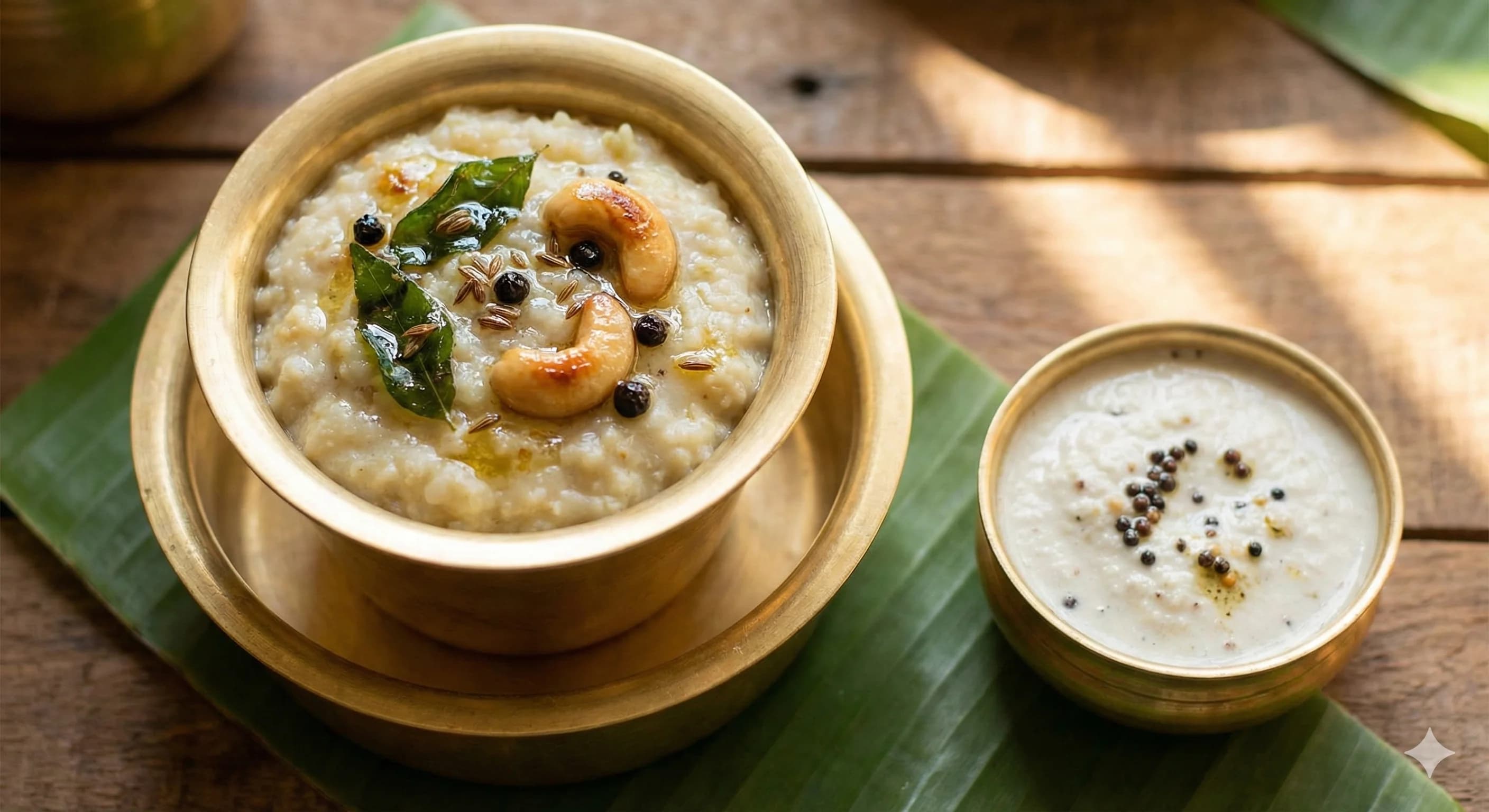
Kodo Millet Pongal
A comforting South Indian one-pot dish where kodo millet and moong dal are cooked together until creamy, then seasoned with a peppery, cumin-scented ghee tempering. This is a millet version of the classic ven pongal -- perfect as a hearty breakfast or satisfying lunch.
Prep Time
10 min
Cook Time
25 min
Servings
3
Difficulty
Easy
Ingredients
- Kodo millet — 3/4 cup (135 g)
- Moong dal (split yellow) — 1/4 cup (50 g)
- Black pepper, coarsely crushed — 1 teaspoon
- Cumin seeds — 1 teaspoon
- Ginger, finely chopped — 1 teaspoon
- Curry leaves — 10-12 leaves
- Cashew halves — 10-12
- Ghee — 2 tablespoons
- Salt — 1 teaspoon
- Water — 3 cups
Instructions
- 1
Dry roast the moong dal in a pan over medium heat for 3-4 minutes until fragrant and lightly golden. Set aside.
- 2
Wash the kodo millet and roasted moong dal together in 2-3 changes of water. Drain.
- 3
In a pressure cooker, combine the washed millet, dal, 3 cups of water, and salt. Pressure cook for 3-4 whistles on medium heat. Let the pressure release naturally.
- 4
Open the cooker and mash the mixture lightly with the back of a ladle to get a creamy, porridge-like consistency. Add a splash of hot water if it is too thick.
- 5
Prepare the tempering: Heat ghee in a small pan. Add cashews and fry until golden. Add cumin seeds and let them crackle. Add crushed black pepper, chopped ginger, and curry leaves. Saute for 30 seconds.
- 6
Pour the entire tempering over the millet-dal mixture and stir well to combine.
- 7
Serve hot with coconut chutney and sambar.
Tips
- •Dry roasting the moong dal before cooking enhances the nutty flavor of the pongal and helps it cook evenly.
- •Pongal should be creamy and slightly loose, not dry. It thickens as it sits, so keep it a little looser than desired while serving.
- •Crush the black pepper coarsely (not fine) so you get distinct peppery bites in each spoonful.