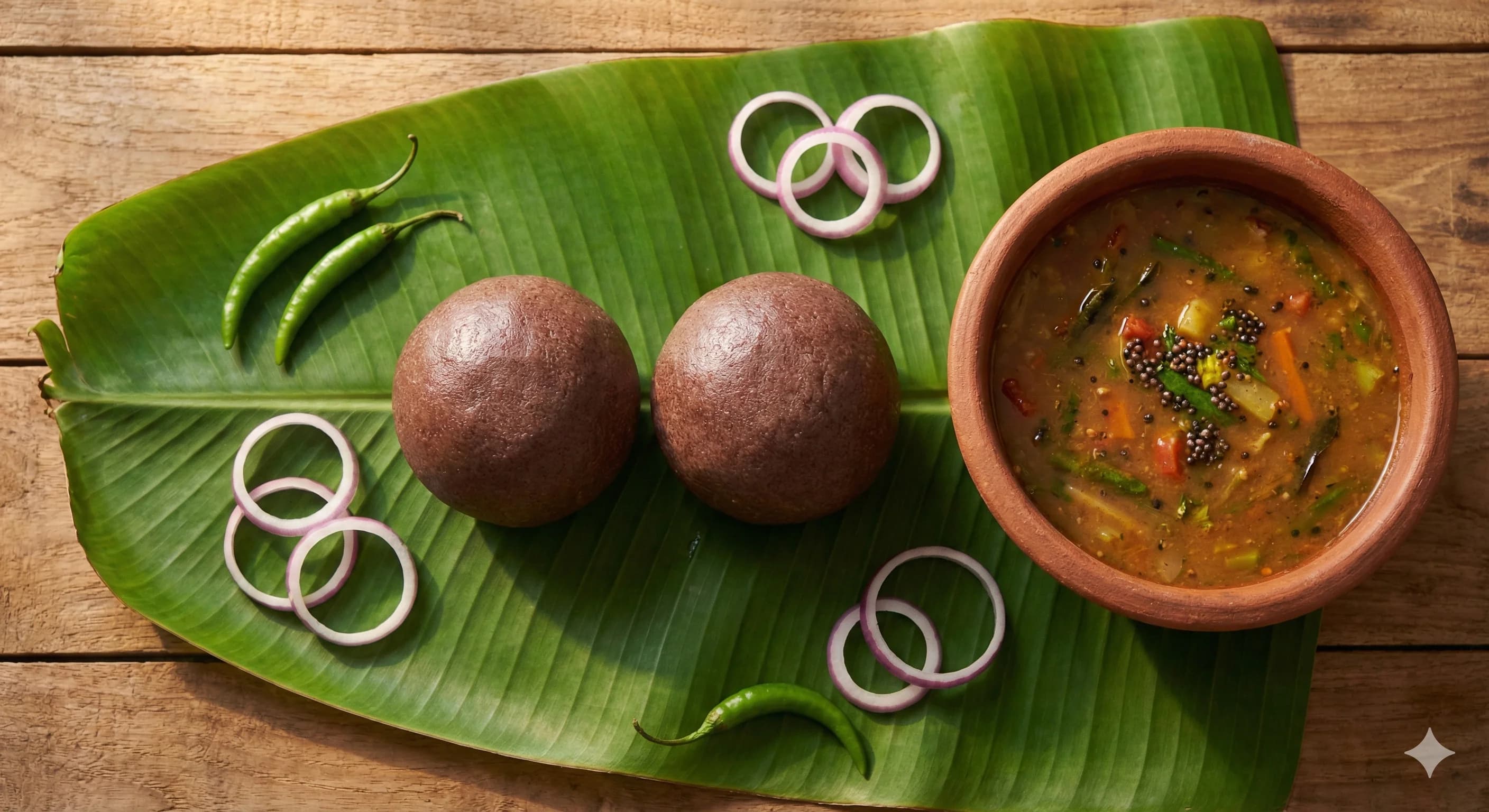
Ragi Mudde (Ragi Balls)
Ragi mudde is the iconic staple of Karnataka -- firm, smooth balls of cooked ragi flour eaten by breaking off pieces and dipping into sambar or saaru (rasam). The technique of vigorous stirring to get a lump-free, dough-like consistency is the key to perfect ragi mudde.
Prep Time
5 min
Cook Time
15 min
Servings
2
Difficulty
Medium
Ingredients
- Ragi (finger millet) flour — 1 cup (120 g)
- Water — 1.5 cups
- Salt — 1/4 teaspoon
Instructions
- 1
Bring 1.5 cups of water and salt to a rapid boil in a heavy-bottomed saucepan.
- 2
While the water is still boiling vigorously, reduce the heat to low. Add 1/4 cup of ragi flour to the water and stir quickly with a wooden spatula (they use a special flat wooden ladle called "mudde onake" in Karnataka).
- 3
Once the first addition is mixed in and the mixture is smooth, add the remaining ragi flour in 2-3 batches, stirring vigorously and continuously after each addition to prevent lumps.
- 4
Keep stirring on low heat for 5-7 minutes. The mixture will pull away from the sides of the pan and form a thick, cohesive dough. It requires significant arm strength -- do not stop stirring.
- 5
When the dough is smooth, glossy, and comes together in a ball, remove from heat.
- 6
Wet your palms with cold water. Scoop out portions of the hot dough and quickly roll between your wet palms to form smooth, round balls.
- 7
Serve immediately with sambar, saaru (rasam), or any spicy curry. The mudde is eaten by pinching off small pieces with fingers and dipping into the accompaniment.
Tips
- •The key to smooth ragi mudde is continuous, vigorous stirring. If you stop stirring, lumps will form and cannot be fixed.
- •Always add the flour to boiling water, never the other way around. Adding flour in batches helps prevent lumps.
- •Wet your palms well before shaping each ball. The dough is very hot, so work quickly. The mudde should have a smooth, shiny surface.